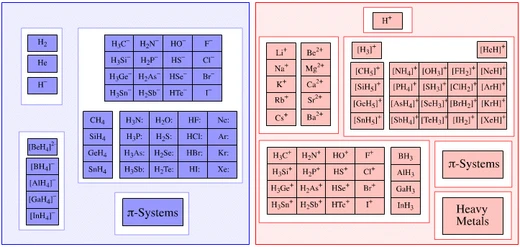
Acid dissociation constant
Quantitative measure of acid strength in solution.

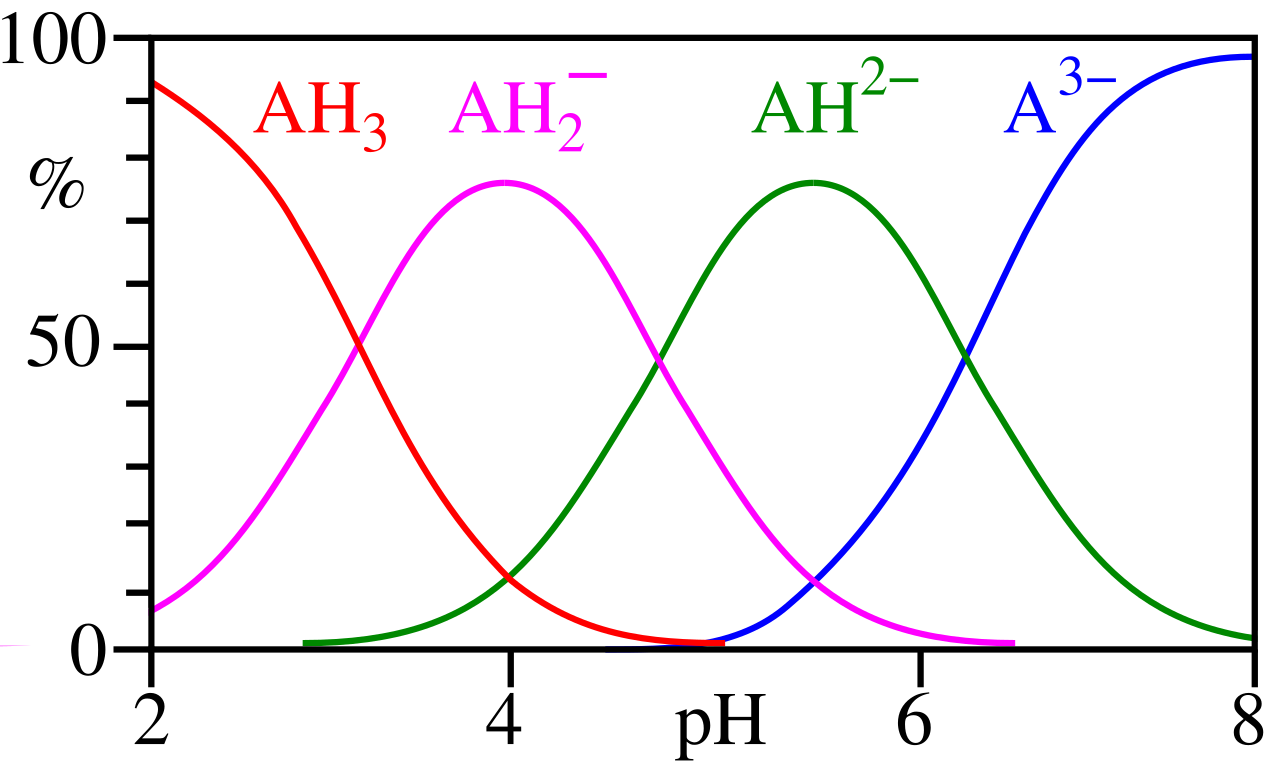
Д.Ильин own work, vectorization, based on File:Citric acid speciation.png by Pet · CC BY-SA 4.0
The acid dissociation constant (Ka) is a quantitative measure of the strength of an acid in solution, defined as the equilibrium constant for the dissociation reaction HA ⇌ A⁻ + H⁺. It is often expressed as pKa = −log₁₀ Ka, where a lower pKa corresponds to a stronger acid. This constant is fundamental in chemistry, biology, medicine, and geology for predicting pH, preparing buffer solutions, and understanding acid–base behavior.
- symbol
- Ka (or pKa)
- definition
- Equilibrium constant for acid dissociation: Ka = [A⁻][H⁺]/[HA]
- logarithmic_form
- pKa = −log₁₀ Ka
- example_weak_acid
- Ka = 10⁻⁵ gives pKa = 5
- example_acetic_acid
- Ka = 1.8 × 10⁻⁵, pKa = 4.7
- temperature_dependence
- pKa changes with temperature; endothermic reactions increase Ka and decrease pKa with rising temperature
- measurement_methods
- Potentiometric (pH) titration for pKa 2–11; spectrophotometric or NMR for extreme values
Lore & Background
The acid dissociation constant arises from the thermodynamics of the dissociation reaction, with pKa directly proportional to the standard Gibbs free energy change. Its value depends on molecular structure, including inductive effects, mesomeric effects, hydrogen bonding, and rules proposed by Linus Pauling for polyprotic acids and oxyacids. The constant is essential for understanding acid–base homeostasis, enzyme kinetics, and the behavior of medicinal compounds in the bloodstream.
Reader's Guide
The acid dissociation constant is a cornerstone of solution chemistry, enabling the prediction of pH from known concentrations and pKa values. It is critical for preparing buffer solutions, studying metal ion complexation, and modeling aquatic chemistry and oceanography. In pharmacology, pKa values combined with octanol-water partition coefficients help estimate drug absorption. The constant's temperature sensitivity, governed by Le Chatelier's principle, and its structural determinants make it a versatile tool across scientific disciplines. Experimental determination relies on potentiometric titration for most pKa values, with spectrophotometric or NMR methods required for very strong or very weak acids.
Did You Know?
- A lower Ka corresponds to a weaker acid, while a lower pKa corresponds to a stronger acid.
- The pKa value is directly proportional to the standard Gibbs free energy change for the dissociation reaction.
- Linus Pauling proposed rules for estimating pKa of polyprotic acids and oxyacids based on molecular structure.
- For pKa values less than about 2 or more than about 11, spectrophotometric or NMR measurements may be required due to practical difficulties with pH measurements.
Gallery

Frequently Asked Questions
Who is Acid dissociation constant?
Ka is the equilibrium constant that quantifies how readily an acid releases a proton in solution, defined as the ratio [A⁻][H⁺] divided by [HA] at equilibrium. It serves as the single numerical yardstick for ranking acids from weak to strong.
What are Acid dissociation constant's powers/role?
Ka lets chemists compute solution pH, engineer buffer mixtures, and compare acid strengths on one unified scale. Its logarithmic counterpart, pKa (equal to −log₁₀ Ka), compresses the vast range of Ka values into a compact window where smaller numbers signal stronger acids.
How does Acid dissociation constant's story end?
Ka is not a permanent constant; its value shifts as temperature changes because dissociation is a reversible equilibrium. For endothermic dissociation, heating the solution raises Ka and lowers pKa, effectively making the acid appear stronger.
Why is Acid dissociation constant important?
From pharmaceutical formulation to geology, Ka underpins every acid–base prediction made in aqueous environments. Knowing a molecule's Ka tells you whether it will sit protonated or deprotonated at a given pH, which governs enzyme function, drug absorption, and mineral solubility.
What are some famous Acid dissociation constant 'cameos'?
Acetic acid, the familiar vinegar component, carries a Ka of roughly 1.8 × 10⁻⁵ (pKa ≈ 4.7), while a generic weak acid with Ka = 10⁻⁵ lands exactly at pKa 5. These everyday examples show how one compact number captures the full dissociation picture.
More in Acids And Bases 1-24
Elsewhere in the Acids And Bases universe
Spotted an error? Know more?
This is a living reference — every entry is fact-audited, and reader corrections feed straight into our audit queue. Suggest an edit · See this site's audit record