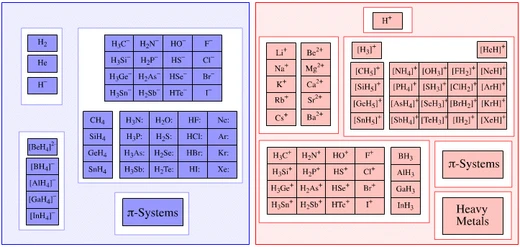
Protonation
Adding a proton to form a conjugate acid.

Protonation (or hydronation) is a fundamental chemical reaction in which a proton (or hydron, or hydrogen cation), usually denoted as H⁺, is added to an atom, molecule, or ion, forming a conjugate acid. It is a core process in acid–base reactions and is essential in many stoichiometric and catalytic processes, as well as in analytical techniques such as electrospray mass spectrometry.
- field
- Chemistry
- known_for
- Adding a proton to form a conjugate acid; central to Brønsted–Lowry acid–base theory
- related_concepts
- Deprotonation, conjugate acid, polybasic species
Lore & Background
Protonation is the complementary process to deprotonation, where a proton is removed from a Brønsted–Lowry acid. Examples include the protonation of water by sulfuric acid to form hydronium and bisulfate ions, the protonation of isobutene to form a carbocation, and the protonation of ammonia to form ammonium chloride. Some ions and molecules can undergo more than one protonation and are labeled polybasic, which is true of many biological macromolecules.
Reader's Guide
Protonation is a fundamental chemical reaction and a step in many stoichiometric and catalytic processes. It is the core of most acid–base reaction theories, with a Brønsted–Lowry acid defined as a substance that protonates another. Upon protonation, the mass and charge of the species each increase by one unit, making it essential in analytical procedures such as electrospray mass spectrometry. Protonation or deprotonation can change many chemical properties, including solubility, hydrophilicity, reduction or oxidation potential, and optical properties. Rates of protonation are often rapid due to the high mobility of protons in many solvents, but can be slow when significant structural changes occur. Enantioselective protonations are under kinetic control and are relevant to organic synthesis and biological processes. Protonation is usually reversible, though in some cases it induces isomerization, such as converting cis-alkenes to trans-alkenes with a catalytic amount of protonating agent. Many enzymes, like serine hydrolases, operate via mechanisms involving reversible protonation of substrates.
Did You Know?
- Protonation is also called hydronation.
- The rate of protonation by weak acids is slower than by strong acids.
- Protonation can change solubility, hydrophilicity, and optical properties of a molecule.
- Enantioselective protonations are under kinetic control and are relevant to biological processes.
More in Acids And Bases 1-24
Elsewhere in the Acids And Bases universe
Spotted an error? Know more?
This is a living reference — every entry is fact-audited, and reader corrections feed straight into our audit queue. Suggest an edit · See this site's audit record